


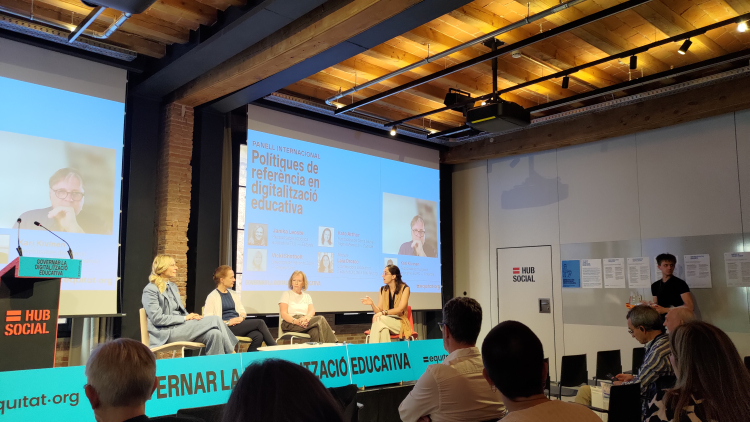
The Equitat Foundation , with the collaboration of more than thirty Catalan entities, organized the 'Governing educational digitalization' conference on Tuesday, May 19, in the morning. With the help of professionals from the educational and research fields, the proposal reflected on the current situation, shared good practices and proposed strategies and actions to promote a digital educational policy that puts equity and well-being at the center. The aim of the meeting was to explore, propose and identify the necessary conditions to take action in Catalonia. In this sense, the first part of the 'Governing educational digitalization' conference featured an international panel on reference policies in educational digitalization with the participation of Kari Kivinen, from Finland, Janika Leoste, from Estonia, Vicki Shotbolt, from the United Kingdom, and Kate Arthur, from Canada. Among the recommendations put forward, there was an urge to work on strengthening digital skills and the use of artificial intelligence tools with citizens, as well as enhancing critical thinking and promoting digital skills linked to security within the digital world.
The second part of the day, 'Governing educational digitalisation', was a conversation about the challenges for critical digitalisation in Catalan education between Vanesa Mases Espinasa, Deputy Director General of Digital Technology and Educational Research at the Department of Education and Professional Training of the Generalitat de Catalunya, and Sandra Ruiz Peralta, Director General of Digital Economy and Society at the Department of Business and Employment of the Generalitat de Catalunya. Mases explained that an education plan had been implemented that had a strong impact on access and resources and that its impact was being assessed. Ruiz explained that a shock plan strategy against digital gaps had been implemented, focusing on older people, and that work was being done on the situation of children and adolescents. Along these lines, Ruiz invited to favor cross-cutting perspectives and an integrated response in order to go further and with clear values of equity to accompany the most vulnerable communities. Mases insisted on how computational thinking is present from kindergarten to high school and from unplugged sets to robotics.
Finally, the third part of the day 'Governing educational digitalization' consisted of a round table on priorities for critical educational digitalization with the participation of Lorenzo Marini, co-founder and head of strategy and impact at the Verificat association, Mireia Vendrell, education specialist at the Institute for Research in Artificial Intelligence of the Higher Council for Scientific Research, and Cristina Molina, mental health leader at the Hospital Sant Joan de Déu Barcelona. The round table agreed on the importance of taking care of digital well-being, working on creativity, imagining new ways of interacting with technology and promoting digital skills around media information and artificial intelligence for young, middle and old. Along these lines, the round table called for promoting shared spaces where reflection and critical thinking can be facilitated between different actors and with a long history, listening to children, adolescents, families and teachers, making them part of the process and taking into account their experiences and life experiences, and promoting public policies, political commitment and political will to make the necessary changes.