


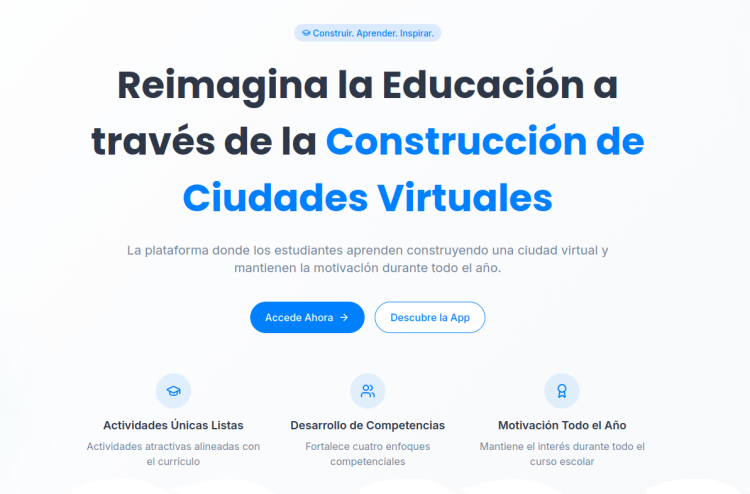
Teacher Òscar Herrero recently presented the educational initiative 'Edurantia' , a virtual city that students manage in a consensual and coordinated manner and where they develop skills and abilities. Born during a professional experience in Bishkek, the capital of Kyrgyzstan, the initiative aims to connect with boys and girls and bring the concepts they work on in the classroom closer to their personal circumstances.
From the Punt TIC Network, we spent some time with him to learn about the educational initiative.
1. What is 'Edurantia'?
'Edurantia' is a virtual city where students from 6th grade of Primary to 2nd year of Secondary Education apply everything they learn in the classroom. Each group, made up of four to six students, manages a virtual city, for example, imitating the functioning of a Council of Ministers. The positions rotate and decisions must be taken in a consensual and coordinated manner. To make it grow, they must earn points in the classroom, helping with daily management through positive reinforcement. In addition, there are learning situations that affect the city, transferring the concepts of the educational curriculum to real-world challenges. When students see their effort and learning reflected in the growth of their city, they are motivated to continue learning. Also, the management of the virtual city promotes the development of skills and abilities, especially entrepreneurship, communication or vocations.
2. How did the initiative come about?
The educational initiative was born in a classroom in Kyrgyzstan, when I was working in the country's capital, Bishkek. I taught history, but my students were very disconnected, since their country did not appear in the educational curriculum. To connect them, I created a dynamic, using a spreadsheet and screenshots of a popular video game, and made their cities interact with the events they were working on in the classroom. The results were very strong and exciting. Participation increased by more than 45% and student performance by nearly 35%. Given this data, I automated the proposal to take it to more classrooms.
3. What resources can trainers find?
There are prepared learning situations, aligned with the LOMLOE criteria (and with the IB MYP criteria) and related to the growth of the virtual city, creating challenges with rubrics and adaptations, reporting panels to track student progress and the performance of boys and girls, panels to give positive reinforcement to students and a vibrant virtual city managed by them autonomously.
4. What learnings do students take away?
Obviously, the learning of the subject. The learning situations bring the skills, criteria, knowledge and concepts of the subject to the real challenges of the city. Therefore, the students internalize this learning in order to be able to apply it. However, what is most surprising is what happens between them. Deciding as a team what to build, with limited money, requires arguing, listening and accepting the consequences of a decision. Each student has a position with responsibilities that the others need, and this means that no one can be left out. The proposal affects cooperation or critical thinking, among others.
5. What role does technology play?
Technology is the medium. The platform allows everything to be possible during an entire course without the teacher having to keep analog accounts: currencies, statistics or student performance.
6. What are the next challenges in the educational field?
We must work on student apathy and this disconnection in the classroom. The real world is changing at an exponential rate, and we must find ways for boys and girls to connect, to see the concepts they work on in the classroom close to their reality, to their everyday lives. Another challenge is the lack of resources in the educational field, more ratios and more bureaucracy, making reaching all students increasingly complicated.